
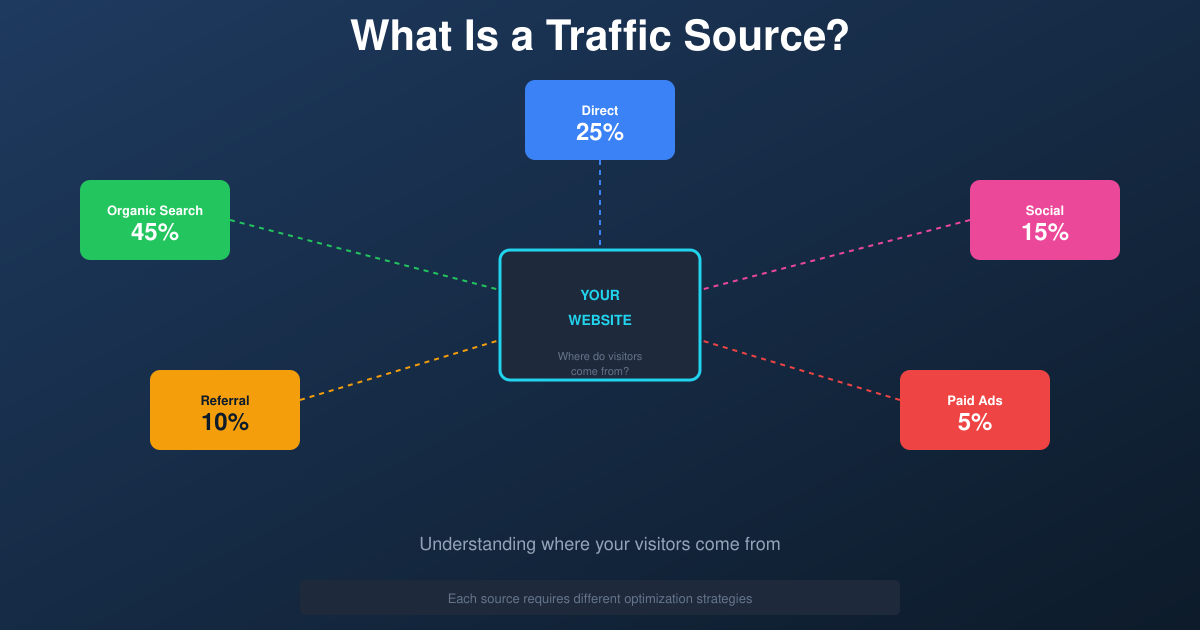
Understanding where your website visitors come from is fundamental to growing your online presence. Traffic sources tell you whether people found you through Google, clicked a link on social media, or typed your URL directly. This knowledge helps you focus your marketing efforts where they actually work.
In this guide, you’ll learn exactly what traffic sources are, how to identify them in your analytics, and most importantly—how to improve each one to grow your business.
Key Takeaways
- Traffic source identifies how visitors find your website—through search engines, direct visits, social media, referrals, or paid ads
- Organic search typically provides the highest quality traffic for most websites, with visitors actively seeking your content
- “Direct” traffic is often misleading—up to 60% may actually be “dark traffic” from untracked sources
- UTM parameters are essential for accurately tracking where your traffic really comes from
- Different industries have different optimal traffic mixes—there’s no one-size-fits-all benchmark
What Is a Traffic Source?
A traffic source is the origin of a visitor to your website. When someone arrives at your site, your analytics tool records where they came from—whether that’s a Google search, a Facebook post, an email link, or typing your URL directly into their browser. This information comes from the HTTP Referer header that browsers send with each request.
Think of traffic sources like the different doors into a store. Just as a retail shop might have a main entrance, a side door from the parking lot, and a mall entrance, your website has multiple ways people can arrive. Understanding which “doors” bring the most valuable customers helps you decide where to focus your efforts.
Why Traffic Sources Matter
Knowing your traffic sources helps you:
- Allocate marketing budget wisely — If organic search brings 50% of your traffic but you’re spending 80% of your budget on ads, something’s off
- Identify growth opportunities — Low social traffic might mean an untapped opportunity if your audience is active there
- Understand your audience — Visitors from different sources have different intentions and behaviors (learn more about how analytics count unique visitors)
- Measure marketing effectiveness — Know which campaigns actually drive results
The Five Main Traffic Sources
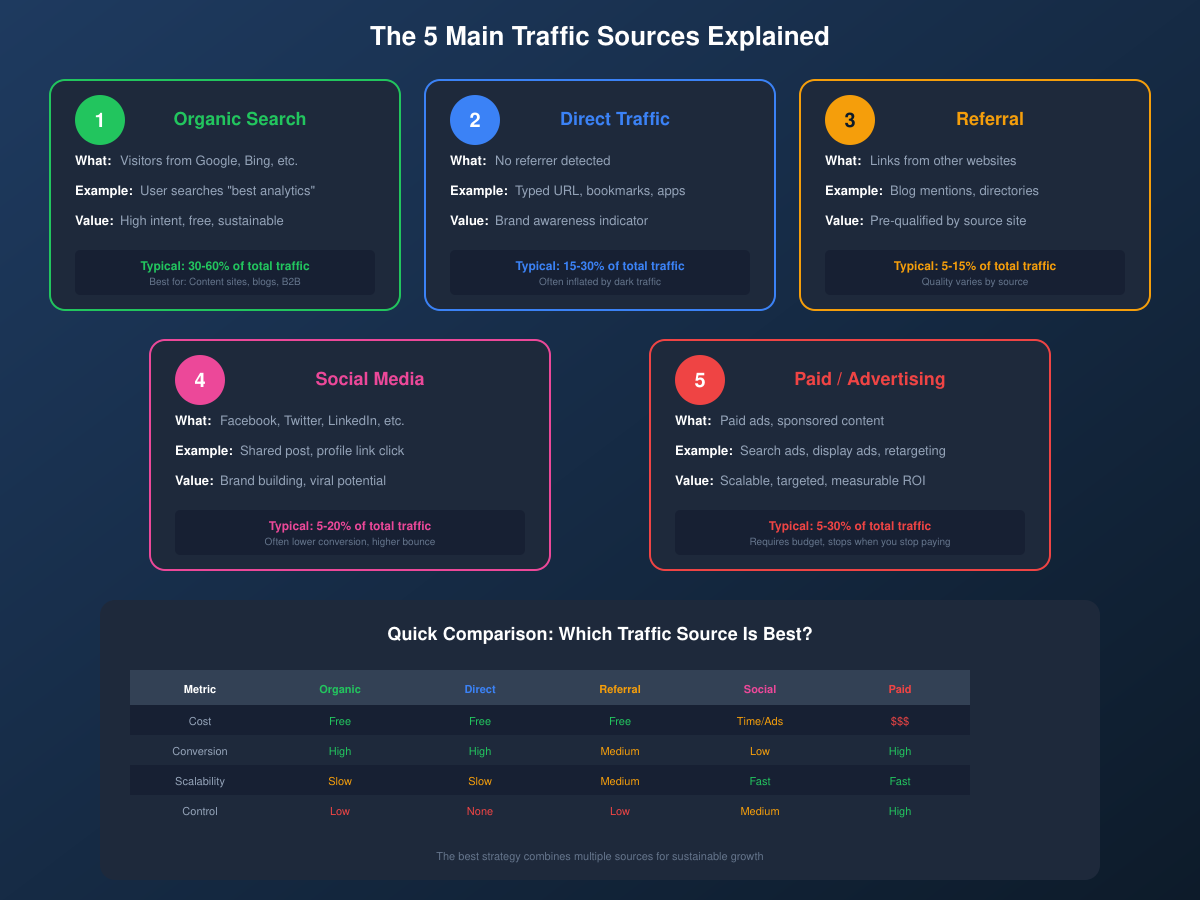
Most analytics tools categorize traffic into five primary sources. Each has distinct characteristics, visitor intent, and optimization strategies.
1. Organic Search Traffic
Organic search traffic comes from unpaid search engine results. When someone searches “how to bake sourdough bread” on Google and clicks a non-ad result, that’s organic traffic.
Characteristics:
- High-intent visitors actively seeking information or solutions
- Free (no cost-per-click), but requires SEO investment
- Compounds over time—good content keeps bringing traffic for years (each visit starts a new session)
- Typically the largest traffic source for content-focused websites
What it looks like in analytics: You’ll see search engines like Google, Bing, DuckDuckGo, or Ecosia listed as sources. Most tools combine these under “Organic Search” as a channel.
2. Direct Traffic
Direct traffic traditionally means visitors who arrive by typing your URL directly into their browser, using a bookmark, or clicking a link with no referrer information.
True direct traffic indicates:
- Brand recognition and loyalty
- Repeat visitors who know your site
- Offline marketing effectiveness (TV, print, word-of-mouth)
However, there’s a significant problem with how “direct” traffic is measured, which we’ll explore in detail below.
3. Social Traffic
Social traffic comes from social media platforms—Facebook, Twitter/X, LinkedIn, Instagram, Pinterest, TikTok, and others.
Characteristics:
- Visitors are often in browse/discovery mode, not actively searching
- Can spike dramatically when content goes viral
- Different platforms serve different audiences and content types
- May require consistent posting to maintain traffic levels
Important note: Traffic from mobile apps (like the Facebook or Instagram app) often doesn’t pass referrer information correctly, causing it to be miscategorized as “direct” traffic.
4. Referral Traffic
Referral traffic comes from links on other websites. If a blog mentions your product and links to your site, visitors clicking that link are referral traffic.
Characteristics:
- Often high-quality, pre-qualified visitors
- Implies third-party endorsement
- Helps with SEO through backlinks
- Can include affiliate traffic, press mentions, and directory listings
Quality matters more than quantity—one link from a relevant, authoritative site beats dozens of links from random directories.
5. Paid Traffic
Paid traffic comes from advertising—Google Ads, Facebook Ads, display networks, sponsored content, and other paid channels.
Characteristics:
- Immediate results (turn on ads, get traffic)
- Highly controllable and scalable
- Requires ongoing budget—stops when you stop paying
- Success depends on ROI, not just traffic volume
Most analytics tools separate paid search (like Google Ads search campaigns) from paid social and display advertising to help you evaluate each channel’s performance.
The Dark Traffic Problem
Here’s something most beginners don’t realize: your “direct” traffic numbers are probably wrong. What analytics tools label as “direct” is often a catch-all category for “we don’t know where this came from.”

What Gets Counted as Direct (But Isn’t)
Mobile app links: When someone clicks a link in the Facebook app, Instagram, or LinkedIn mobile app, the referrer information often gets stripped. These visitors show up as “direct.”
Messaging apps: Links shared via WhatsApp, Slack, Telegram, or Discord typically don’t pass referrer data.
Email without tracking: If you send emails without UTM parameters, those clicks appear as direct traffic.
HTTPS to HTTP: Links from secure (HTTPS) sites to non-secure (HTTP) sites don’t pass referrer information due to browser security policies.
QR codes without tracking: QR codes point directly to URLs, so without UTM parameters, they show as direct.
PDF and document links: Links in downloaded PDFs, Word documents, or presentations don’t pass referrer data.
How Much of Your Direct Traffic Is Actually Direct?
Studies suggest that 40-60% of what’s labeled as “direct” traffic is actually “dark” traffic from unknown sources. If your analytics shows 30% direct traffic, the true figure might be closer to 12-18%.
Rule of thumb: If your direct traffic exceeds 30% of total traffic, you likely have a dark traffic problem that’s hiding your true marketing performance.
UTM Parameters: Solving the Attribution Problem
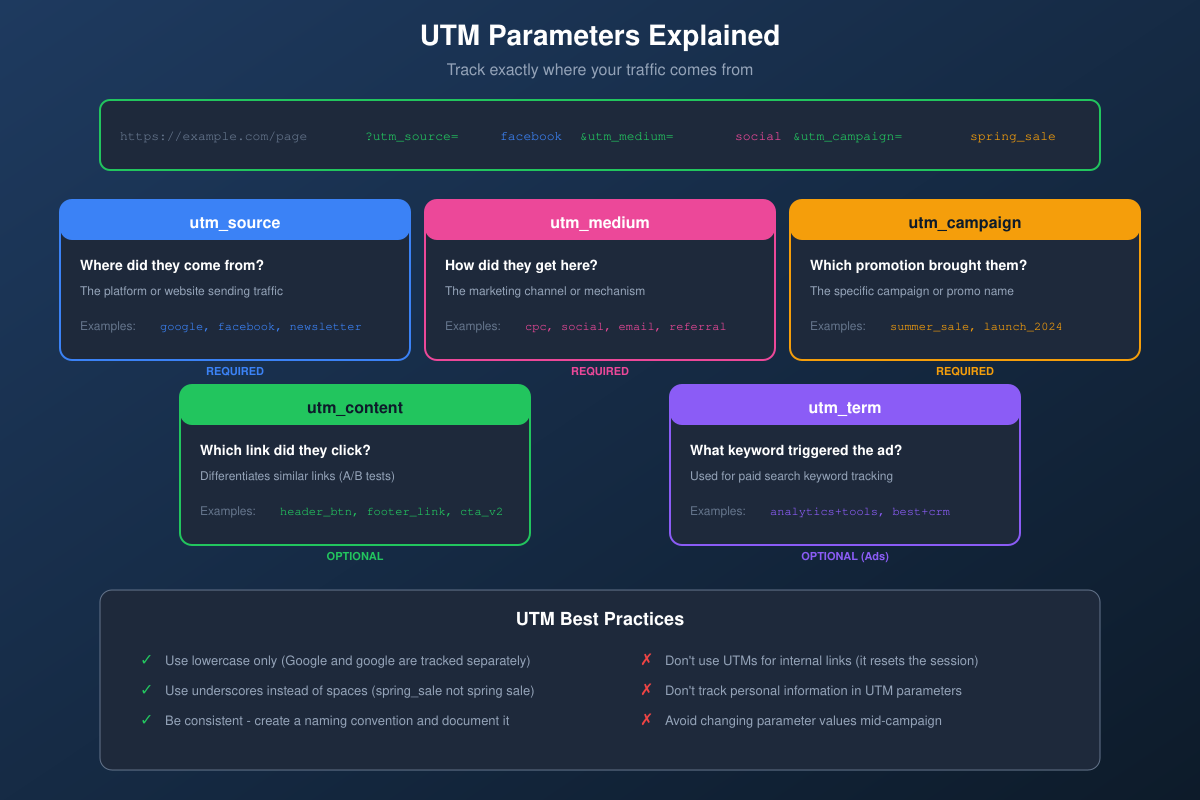
UTM parameters are tags you add to URLs to track exactly where traffic comes from. They’re the best solution for eliminating dark traffic and understanding your true traffic sources. UTM stands for “Urchin Tracking Module”—named after Urchin Software, the company Google acquired to create Google Analytics.
The Five UTM Parameters
utm_source (required): Identifies where the traffic comes from. Examples: facebook, newsletter, partner_site
utm_medium (required): Identifies the marketing channel. Examples: social, email, cpc, banner
utm_campaign (required): Identifies the specific campaign. Examples: spring_sale, product_launch, weekly_digest
utm_content (optional): Differentiates similar links. Examples: header_cta, sidebar_link, blue_button
utm_term (optional): Tracks keywords for paid search. Examples: analytics_tools, crm_software
UTM Best Practices
Use lowercase consistently. UTM parameters are case-sensitive. “Facebook” and “facebook” will be tracked separately, creating messy data.
Use underscores or hyphens, not spaces. URLs can’t contain spaces. Use spring_sale instead of spring%20sale.
Create a naming convention. Document your UTM structure so your entire team uses the same format. Inconsistency defeats the purpose.
Never use UTMs for internal links. Adding UTM parameters to internal links resets the session and overwrites the original source data. Only use UTMs on external links pointing to your site.
Traffic Benchmarks by Industry
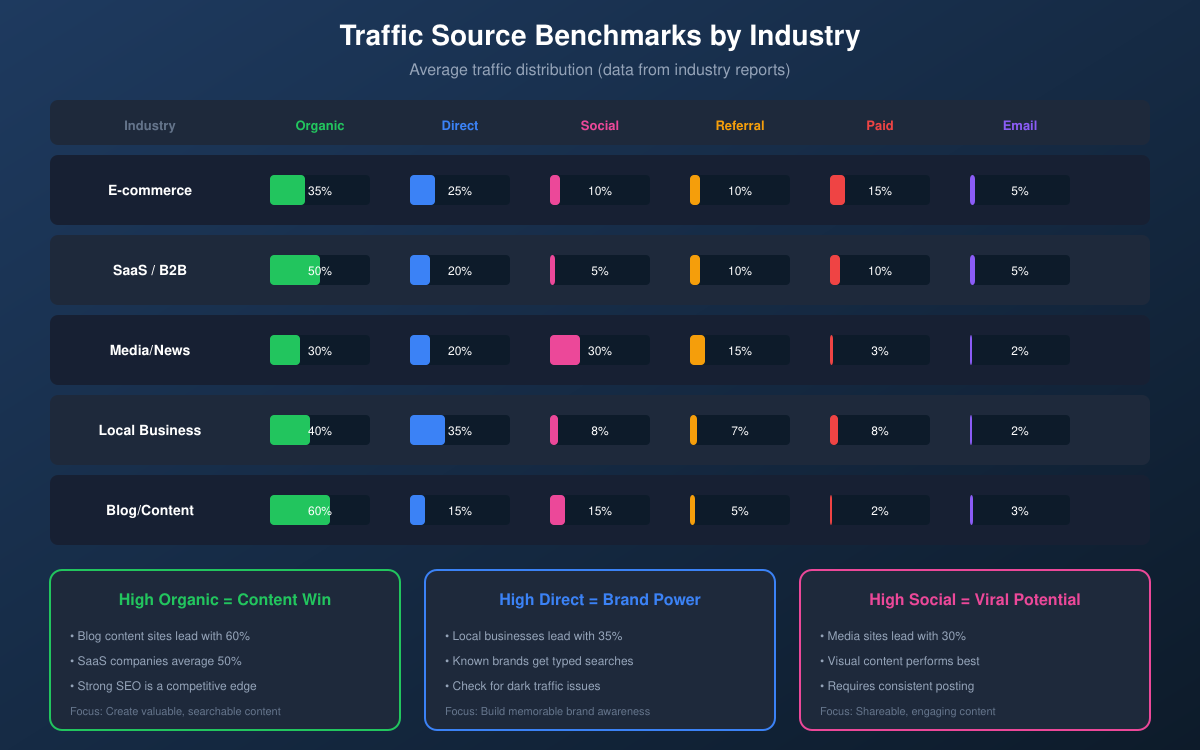
What’s a “good” traffic mix? It depends entirely on your industry, business model, and marketing strategy. Here are typical distributions to use as a starting point for comparison.
E-commerce Sites
E-commerce businesses typically see more paid traffic (10-20%) than other industries because of Google Shopping ads and retargeting campaigns. Organic search remains important for product discovery, while email often drives repeat purchases.
SaaS and B2B
B2B companies often see the highest organic search percentages (40-60%) because their audiences actively research solutions. Content marketing and SEO are typically the primary growth drivers, with longer sales cycles making attribution more complex.
Media and Publishing
News and media sites see significant social traffic (20-40%) because content sharing is core to their distribution model. Viral potential is highest in this category, but traffic can be volatile.
Local Businesses
Local businesses typically have higher “direct” traffic (25-40%) because customers remember the business name and type it directly. Local SEO (Google Maps, “near me” searches) plays a crucial role in organic traffic.
Blogs and Content Sites
Content-focused sites can achieve 50-70% organic search traffic with good SEO. Paid traffic is typically minimal, while social can vary widely based on the content type and audience.
How to Improve Each Traffic Source
Once you understand where your traffic comes from, you can develop strategies to improve each channel.
Growing Organic Search Traffic
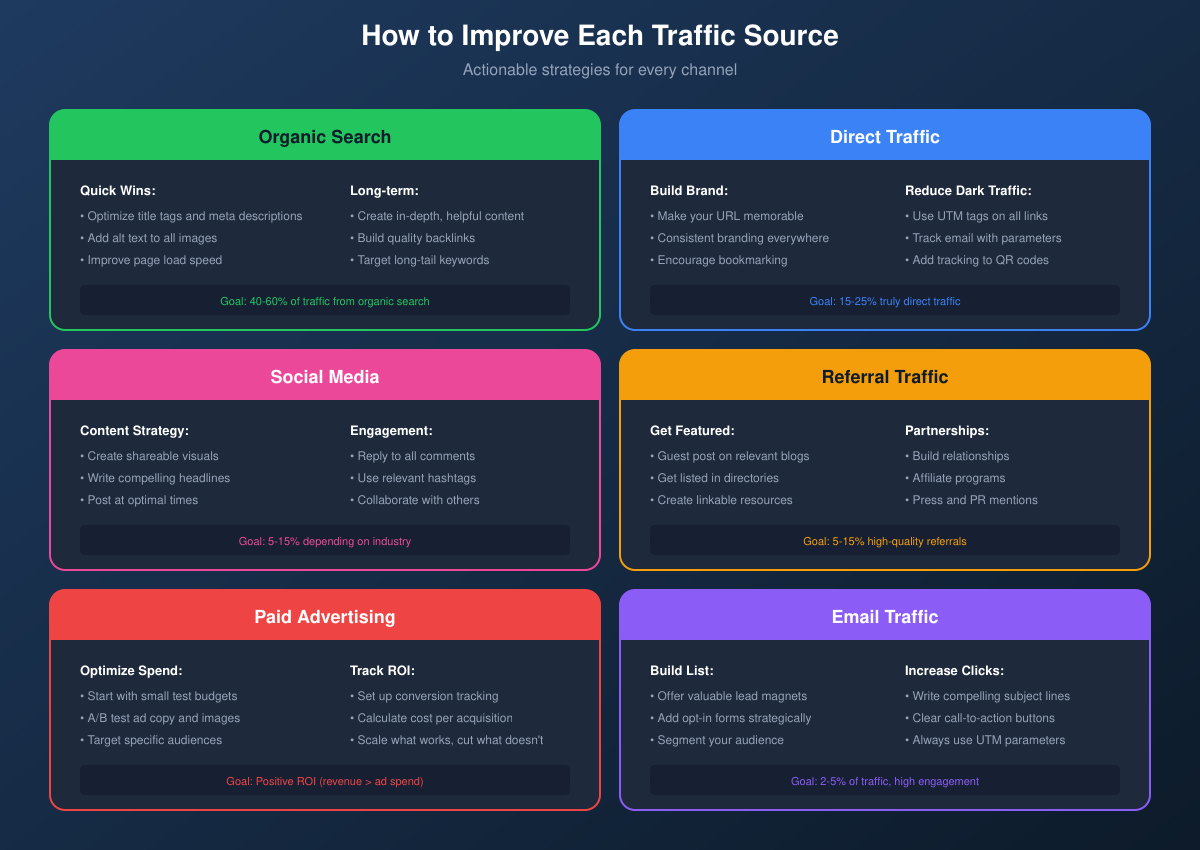
Quick wins:
- Optimize title tags and meta descriptions for click-through rate
- Add descriptive alt text to all images
- Improve page load speed (compress images, enable caching)
- Fix broken links and 404 errors
Long-term strategies:
- Create comprehensive, helpful content that answers search queries
- Build quality backlinks through outreach and valuable resources
- Target long-tail keywords with lower competition
- Maintain fresh, updated content
Building Direct Traffic (Brand Awareness)
Brand building:
- Choose a memorable, easy-to-type domain name
- Maintain consistent branding across all channels
- Encourage visitors to bookmark your site
- Create a memorable experience that people want to return to
Reduce dark traffic:
- Use UTM parameters on all external links you control
- Add tracking to email campaigns
- Include UTM parameters in QR codes
- Tag all social media links
Increasing Social Traffic
Content strategy:
- Create visually appealing, shareable content
- Write compelling headlines that make people want to click
- Post at optimal times when your audience is active
- Tailor content format to each platform
Engagement tactics:
- Respond to comments and messages promptly
- Use relevant hashtags strategically
- Collaborate with others in your space
- Build genuine community around your brand
Getting More Referral Traffic
Get featured on other sites:
- Write guest posts for relevant blogs
- Get listed in industry directories and resource pages
- Create linkable assets (original research, tools, templates)
- Respond to journalist queries (HARO, Qwoted)
Build partnerships:
- Develop relationships with complementary businesses
- Consider affiliate programs where appropriate
- Seek press coverage and PR opportunities
Optimizing Paid Traffic
Efficiency improvements:
- Start with small test budgets before scaling
- A/B test ad copy, images, and landing pages
- Use detailed audience targeting
- Focus on high-intent keywords
ROI focus:
- Set up proper conversion tracking
- Calculate cost per acquisition for each campaign
- Scale what works, quickly cut what doesn’t
- Consider the full customer lifetime value, not just first purchase
Viewing Traffic Sources in Privacy-First Analytics
Modern privacy-first analytics tools like Plausible, Umami, Fathom, and Matomo all provide traffic source reporting, though the interface varies.
Plausible Analytics shows sources on the main dashboard, breaking down by Source (where they came from), Medium (channel type), and Campaign (UTM campaign). The interface is clean and immediately shows your top traffic sources.
Umami displays referrers in a dedicated section, showing both the referring domain and the full referrer URL for more context.
Fathom focuses on simplicity, showing referrers ranked by visitor count with the ability to drill down into specific sources.
Matomo offers the most detailed breakdown, similar to traditional analytics, with acquisition reports covering channels, websites, social networks, and campaigns.
All these tools fully support UTM parameter tracking, making it easy to see your tagged campaigns alongside organic traffic sources.
Common Traffic Source Mistakes
Obsessing over total traffic instead of quality. 100 visitors who convert are worth more than 10,000 who bounce. Look at conversion rates and engagement by source, not just volume.
Ignoring dark traffic. If you’re not using UTM parameters, you’re flying blind. Implement proper tracking before making strategic decisions based on your data.
Comparing yourself to wrong benchmarks. A local bakery shouldn’t expect the same traffic mix as a SaaS company. Compare within your industry and business model.
Putting all eggs in one basket. Depending entirely on one traffic source is risky. Algorithm changes or platform policy shifts can devastate your traffic overnight.
Using inconsistent UTM parameters. Without a documented naming convention, you’ll end up with fragmented data that’s hard to analyze.
Frequently Asked Questions
What’s the best traffic source?
There’s no universal “best” source—it depends on your business. Organic search traffic is often considered highest value because visitors are actively seeking what you offer. However, the best source is whichever one brings visitors who convert and become customers.
Why is my direct traffic so high?
High direct traffic (over 30%) usually indicates dark traffic—visits from sources that aren’t properly tracked. Implement UTM parameters on all external links, email campaigns, and QR codes to reduce dark traffic and see your true source distribution.
Can I see traffic sources without Google Analytics?
Yes. Privacy-first analytics tools like Plausible, Umami, Fathom, and Matomo all track traffic sources. They provide the same core functionality—showing where visitors come from—while respecting user privacy.
How often should I check my traffic sources?
Weekly reviews are sufficient for most businesses. Look for trends over time rather than day-to-day fluctuations. Monthly deeper analysis helps identify seasonal patterns and long-term shifts.
Should I focus on one traffic source or diversify?
Diversification is generally safer. While you might double down on your highest-performing source, maintaining presence across multiple channels protects you from sudden changes (like algorithm updates or platform changes) that could wipe out your traffic.
Summary
Understanding your traffic sources is fundamental to effective marketing. The five main sources—organic search, direct, social, referral, and paid—each require different strategies and serve different purposes. Be aware that “direct” traffic is often inflated by dark traffic from untraceable sources, and use UTM parameters to get accurate attribution data.
Your optimal traffic mix depends on your industry and business model. Focus on quality over quantity, track your sources properly, and continuously optimize each channel based on what actually drives conversions for your business.